Table of Contents
I live in a part of the world where data centers are multiplying rapidly, amid a great deal of controversy and public outcry. Nobody wants a data center in their backyard, and few people are happy knowing that their energy bills will likely go up to pay for them. And yet, at the same time, we are benefitting from artificial intelligence every time we log onto the internet, tune into our favorite subscription service or, as with writers like me, ask AI to help tighten an article or suggest a better headline. AI generated the image that heads this article.
But as we become more reliant on technology, using our own abilities less and AI more, what are we giving up?
Putting the Person at the Center
Pope Leo XIV recently issued a powerful warning to the world about the responsible use of artificial intelligence. In his groundbreaking encyclical, Magnifica Humanitas ("Magnificent Humanity"), he suggests that this technology needs to be "disarmed" as it rapidly alters our daily rhythms, changes the way nations wage war, and transforms how organizations conduct their affairs. At the very heart of his message is a gentle but firm reminder: every institution, whether a global tech firm or a local enterprise, must put the human person at the absolute center of the AI endeavor.
For those of us in the business world, there is a profound wake-up call here. It’s easy to see how the physical presence of these massive, humming server facilities, consuming vast acres of land, power, and local water reserves, mirrors a much quieter, spiritual trade-off happening right at our desks. Corporate leaders who rush to embrace AI simply to streamline operations, cut overhead, or chase raw speed are crossing a dangerous threshold: treating the human person as a line-item expense or an interchangeable cog in a machine.
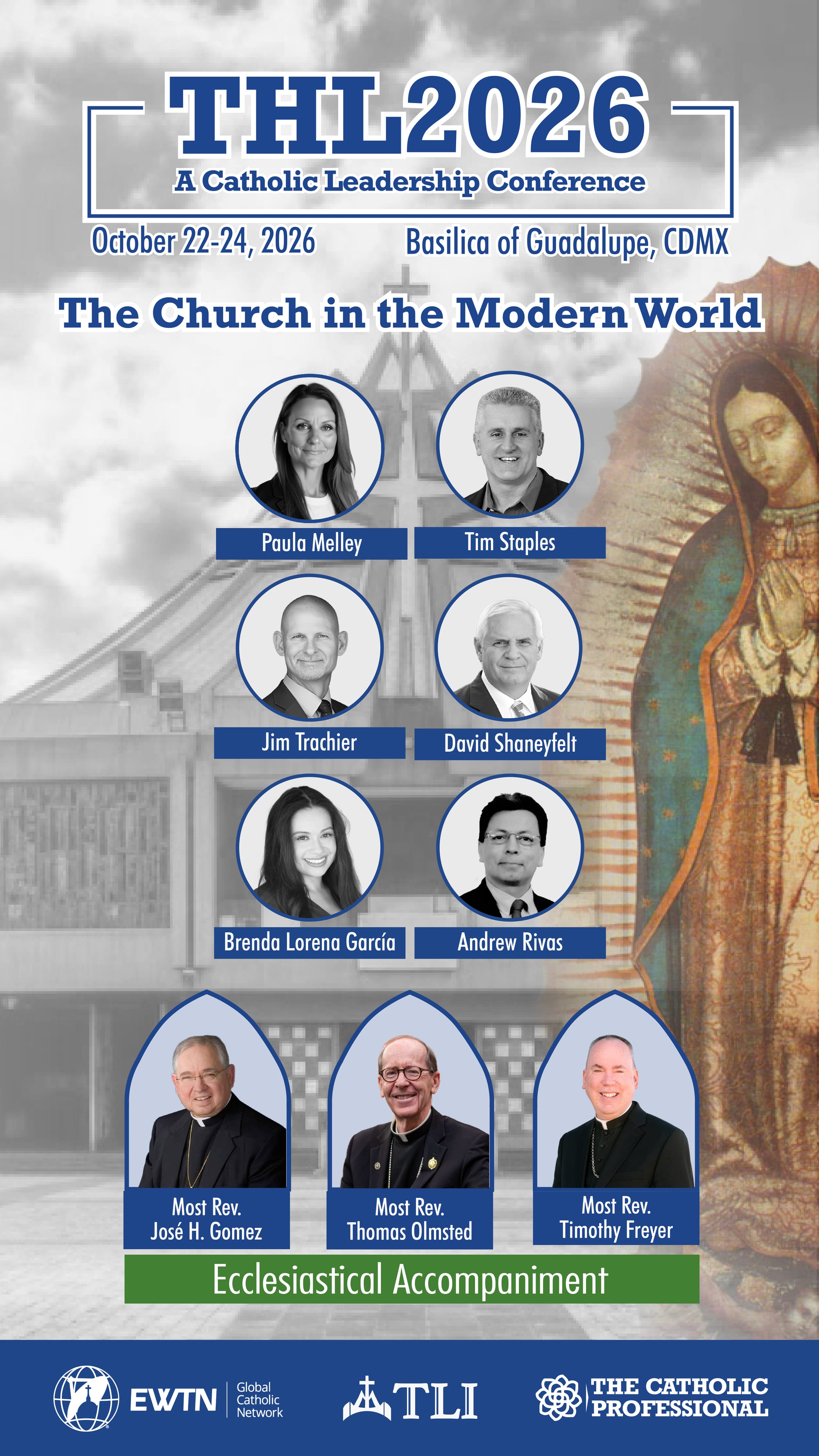
Ad: Discover the place where Our Lady of Guadalupe appeared to St. Juan Diego. See her image. And join Archbishop José Gómez, Bishop Thomas Olmsted and Bishop Timothy Freyer for The Hour of the Laity 2026 in Mexico City.
Work Exists for Human Flourishing
Catholic Social Teaching gives us a much-needed moral compass for this moment. Decades ago, Saint John Paul II reminded us in Laborem Exercens of the priority of labor over capital: work exists to serve human fulfillment and dignity, not the other way around. When enterprise leaders view AI purely as a tool for headcount reduction, we miss the point of human effort entirely. The frustration we feel over humming power grids and rising electric bills in our neighborhoods is really just the physical manifestation of a deeper friction, the subtle temptation to trade human agency and community stability for algorithmic convenience.
This is where the Catholic principle of subsidiarity comes home to roost for modern executives. Subsidiarity reminds us that decisions should always respect the capacity, creative judgment, and inherent worth of those closest to the work. When artificial intelligence is used to strip employees of their creative autonomy or reduce frontline human discernment to a series of automated metrics, it breaks a sacred trust.
A Tool to Serve, Not a Master to Obey
Our call as business professionals isn't to retreat from technological progress, but to ensure that automation serves to uplift and expand human capability, rather than replace it. A truly ethical approach to AI means building systems that augment human talent, safeguard just wages, and protect the livelihoods of the very people who give our organizations their soul. Those vast data centers rising across our horizon are a quiet reminder: if we measure human value strictly by speed and output, the machine will always win. But efficiency was never the goal of human life, flourishing is. Our duty is to keep technology where it belongs: as a servant to humanity, never its master.
P.S. Join Archbishop José Gómez, Bishop Thomas Olmsted and Bishop Timothy Freyer for The Hour of the Laity 2026 in Mexico City. In the videos bellow you will see what they have to say about THL2026.
Ad: Tepeyac Leadership’s Leadership for the World is a $2 million, three year mission to form lay Catholic leaders for the public square. Without formation, others fill the void. Will you step in or step aside now, when it matters most?