


I think it is very good that you should try daily to increase the depth of your concern for those under you. For to feel surrounded and protected by the affectionate understanding of the one in charge, can be the effective help which is needed by the people you have to serve by means of your governance.[i]
The Oxford dictionary offers three definitions for “leadership”: 1) the state or position of being a leader, 2) the ability to be a leader or the qualities a good leader should have, 3) a group of leaders of a particular organization, etc.[ii] In other words, the dictionary is of no help. It describes the destination but offers no map for the journey. If one looks at the Real Academia Española, the definitions are almost identical in Spanish.
Meanwhile, in the corporate world, leadership is often thought of as effective management or result-oriented guidance from one or a few enlightened—perhaps gifted—individuals. If you ask anyone about leadership in the Catholic world, they are sure to point to the highest ranks in the clergy. But still, most are only thinking of positions, not the true virtues of a leader or the betterment of humanity through their leadership.
This is why today “leadership” has become an industry in itself. Every year there are many new books for becoming a “leader,” and dozens of well-groomed, charismatic folk claim to have the ultimate leadership conference, system or pathway to transform someone into a leader. But this is an ever-failing promise considering there is a lack of consensus to describe what a leader is. Leadership is a human thing that most of us can instinctively recognize but have a hard time defining. And something that is undefined cannot be a goal.
We subscribe to the Virtuous Leadership Institute’s definition of a leader: someone who accomplishes great things by bringing out the greatness in others. A leader—as we see it and for the purposes of this book encouraging the Catholic laity—is a person of character who makes the most of the human capital under his or her care to realize great objectives. These objectives we circumscribe to anything that upholds, safeguards or guarantees the dignity of the human person. Nothing can be more important. And they can be achieved in many realms of secular human activity.
If you now begin to see the silhouette of a leader, we still need to determine how someone becomes one “who accomplishes great things.” Thus, we inevitably find ourselves seeking the wisdom of our Mother Catholic Church. For someone to inspire greatness in others, that person must first have taken on the lifelong commitment of shaping his or her character by growing in virtue. It is not a matter of arrival; it is a matter of taking on the journey with intentionality. That is what others will distinctively recognize and be immediately attracted to. When people observe and appreciate the great journey a leader has undertaken, they cannot help but to be attracted to it and want to embark on it themselves, too.
We want to ignite in lay Catholic professionals a thirst for greatness. If you were looking for the way, we hope to point you in the right direction. Every lay Catholic leader’s journey starts by identifying specific issues of concern in society today. These need to be studied closely from the Catholic lens. The study of the issues should be followed by prayer. It is here where the Holy Spirit will usually plant a burning desire in the leader’s heart to act on a specific area. Each leader must enter this discernment process to recognize the concrete ways in which God is calling him or her to lead. From that discernment, the leader must take the time to present in front of God an individual commitment to lead. It’s a beautiful process—led entirely by the Holy Spirit—that us authors have now had the blessing of witnessing several times.
So, this is how we define Catholic Leadership for Civil Society—by action! Lay Catholic leaders in civil society are those Catholics who ultimately roll up their sleeves and serve, allowing God to work on each of them first, so they can then go out to accomplish great things for God’s greater glory. Some might think of this vision as idealistic. We prefer to think of it as faith-filled, for the source of their Catholic leadership ultimately comes from each lay Catholic leader’s identity as a follower of the greatest leader of all, our Lord Jesus Christ.
Great is the LORD and worthy of much praise, whose grandeur is beyond understanding. One generation praises your deeds to the next and proclaims your mighty works. They speak of the splendor of your majestic glory, tell of your wonderful deeds. They speak of the power of your awesome acts and recount your great deeds.
They celebrate your abounding goodness and joyfully sing of your justice.[iii]
In the pages that follow we would like to lay out the vision for rediscovering and reinvigorating lay Catholic leadership, which we humbly bring to the feet of Our Lady of Guadalupe—inspired by the faithfulness of St. Juan Diego—and dare to call Catholic Leadership for Civil Society.
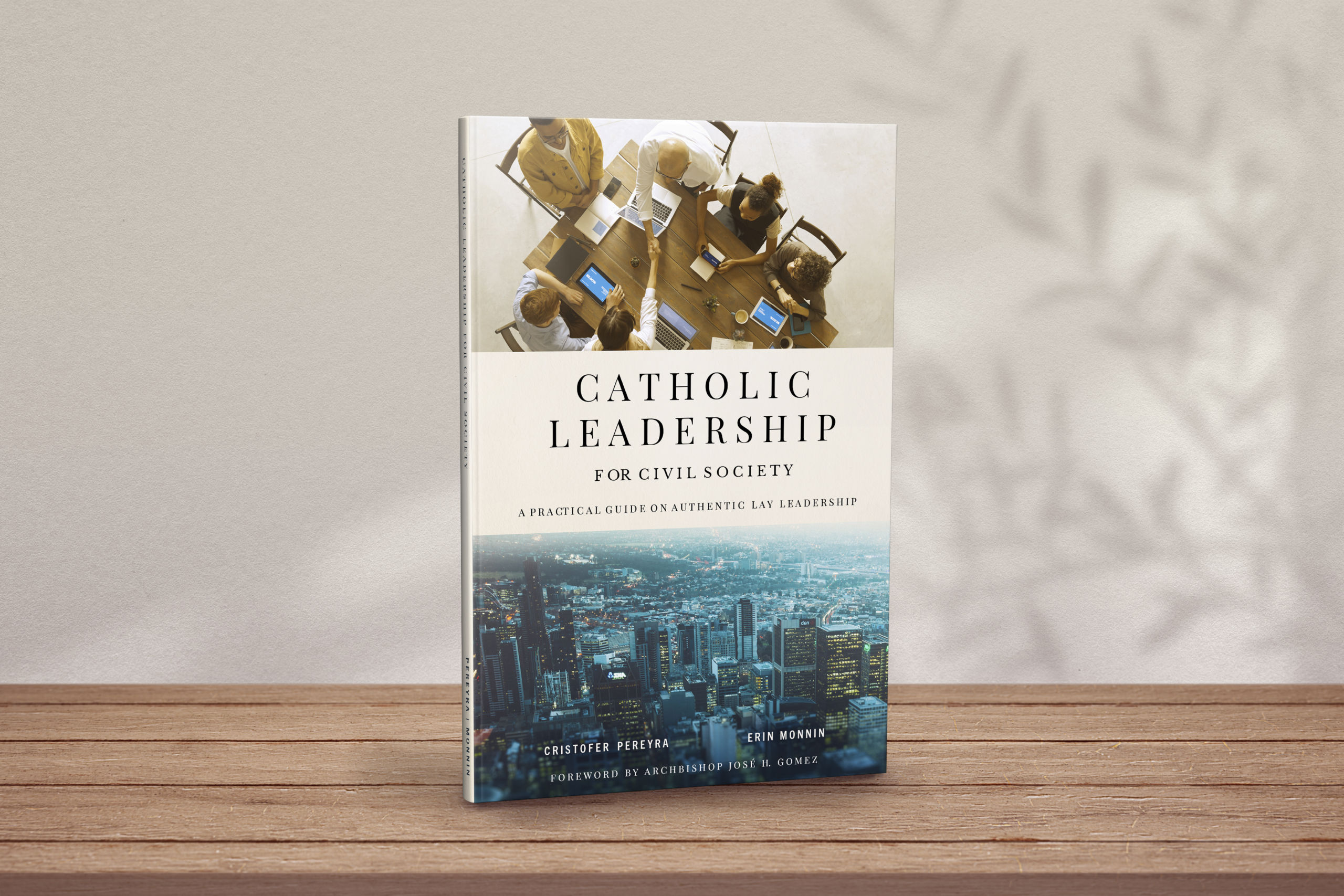
The above chapter comes from the book Catholic Leadership for Civil Society. Listen to the audio version of this chapter, here.
Click here to read part 4 of 4 in our CLCS series.
[i] Josemaría Escrivá. Furrow (London-New York: Scepter, 1987), No. 395.
[ii] Oxford Advanced Learner’s Dictionary, s.v. “Leadership.”
[iii] Ps. 145:3-7 NABRE




)