Recently, in his address to members of the European Conservatives and Reformists Group of the European Parliament, Pope Leo XIV offered a profound reflection rooted in the Church’s perennial teaching on human dignity, the common good, and the role of faith in the public square. Although addressed to a specific political delegation, the Holy Father’s words carry universal guidance for Catholic professionals, whether they serve in business, education, health care, law, science, technology, or public service. The core message is a call to witness Christ in every sphere of professional life by promoting human dignity, fostering respectful dialogue, and contributing to the flourishing of human communities.
The Moral Significance of Professional Life
At the heart of Pope Leo’s address is the truth that every professional activity is permeated with moral significance because it affects real persons who bear the image of God. The Pope reminded his listeners that positions of responsibility, whether in parliament or in the corporate boardroom, carry with them the duty to advance the common good and to attend especially to those on the margins, those whom Jesus Christ called the least among us. This call to preferential attention for the vulnerable is not a political slogan but a profound expression of Catholic social teaching, rooted in the dignity of the human person from conception to natural death and expressed in the Catechism as a yardstick for human flourishing.
Applying Catholic Principles in Leadership
For Catholic professionals, this teaching takes on concrete shape in how we exercise leadership and make decisions. It means asking not only, What is efficient, or What is profitable, but also, What respects the dignity of every human being affected by this decision. In health care, it means advocating for care that honors patients as persons, not commodities. In education, it means forming students not merely for the job market but for a life of virtue and service. In law and public policy, it means protecting rights grounded not in shifting cultural norms but in what it means to be made in God’s image.
The Call to Civil Discourse
Pope Leo also emphasized the importance of civil discourse as a witness to reverence for every person. He praised the ability to hold and debate diverse opinions with courtesy and respect, recognizing that the ability to disagree, listen attentively, and even to enter into dialogue with those whom we may regard as opponents is itself a testimony to human dignity. For professionals today, especially in an age of polarization and rushed judgments, this call to respectful engagement is vital. In business negotiations, in academic discourse, and in digital communication, Catholics are called to be ambassadors of Christ’s peace by promoting dialogue that seeks understanding, not domination.
Drawing from the Cultural and Spiritual Legacy
Integral to the Pope’s message is the affirmation that the cultural legacy of Christianity is not a relic of the past but a living source of ethical principles and intellectual patrimony that enable societies to face current challenges. He pointed to Europe’s spiritual and cultural heritage, including art, music, and institutions of learning, as testimony to the Christian roots that helped shape Western civilization. Likewise, Catholic professionals in every culture bear a similar heritage, the Communion of Saints, the wisdom of the Church Fathers and Doctors, and the moral insights of the social magisterium. These are not burdensome traditions but resources for truth seeking, ethical formation, and courageous witness in fields that too often sacrifice the transcendent to utilitarian ends.
Faith and Reason in Professional Life
This thinking aligns with the Church’s conviction that faith and reason are complementary. Professionals should not feel pressure to compartmentalize their faith, rather, their Catholic identity enriches their reasoned work. By bringing the light of Christ into their professions, Catholic workers help ensure that decisions are not merely technically sound but morally wise. This is especially true in fields such as emerging technology, bioethics, environmental stewardship, and economic policy, where ethical ambiguities abound.
Pope Leo concluded with a reminder that advancing the common good is not merely about preserving traditions but about ensuring a future in which human dignity flourishes. That task belongs to all of us, lay and ordained, wherever we serve. For Catholic professionals, this summons is a daily vocation, to let Christ shape our work, to serve others with compassion, and to build a society that reflects the love of God for every human person.
Note: find the full draft of the Pope's address, here.
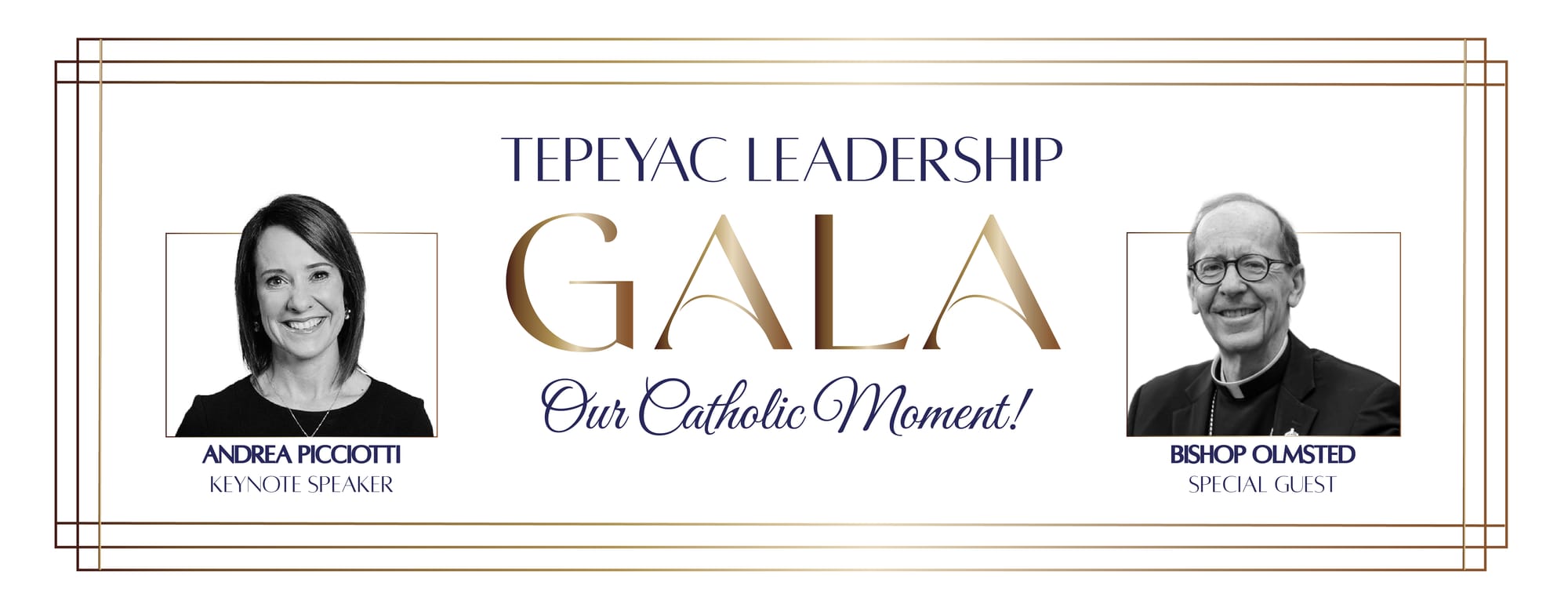
P.S. The date has been set for the 2nd Tepeyac Leadership Gala. Click below to register and mark your calendar to join us!