Table of Contents
In recent years, a growing sense has taken hold among policymakers and observers alike that the geopolitical order forged in the aftermath of the Second World War is giving way to something new. This perception was articulated clearly by Secretary of State Marco Rubio during his opening remarks before the Senate Foreign Relations Committee in January 2025. He argued that once prosperity spread across the United States and much of the world, a "dangerous delusion" of lasting unity took root. That illusion, he warned, blinded nations to emerging threats and shifting realities. Recent actions by the United States, including moves against authoritarian regimes in the Western Hemisphere and the capture and arrest of Venezuela's Nicolas Maduro, suggest a change in paradigm is already underway.
The End of a Familiar Order
For decades, the post-war order rested on American leadership, multilateral institutions, free trade, and security alliances. This framework helped prevent large-scale conflict among major powers and fostered economic growth. Yet it also assumed that shared rules and norms would be respected indefinitely. Rubio’s critique strikes at the heart of this assumption. The world, he argues, has changed. Strategic competitors exploit openness without embracing responsibility, while criminal networks and authoritarian regimes undermine stability from within. The result is an international system no longer capable of delivering security and justice.
America’s Reordered Priorities
The United States is responding by reordering its priorities. Strength at home, economic resilience, border security, and the protection of citizens are no longer seen as secondary to global engagement, but as prerequisites for it. Actions taken against the Venezuelan regime, framed as responses to narcotrafficking, corruption, and human rights abuses, signal a willingness to act decisively in defense of national and regional security. Whether one views these measures as overdue or destabilizing, they reflect a broader shift away from passivity and toward assertive action.
An Uncertain Global Future
What this new geopolitical order will look like in one, two, or four decades remains unknown. It may evolve into a more fragmented world, marked by competing spheres of influence. It may settle into a new balance shaped by deterrence and renewed alliances. Or it may continue to fluctuate amid crises and realignments. History rarely unfolds in straight lines. While trends can be identified, outcomes cannot be predicted with certainty. Only God knows how events will ultimately unfold and how many chapters remain to be written.
No Earthly Paradise
From a Catholic perspective, this uncertainty is neither surprising nor discouraging. The Church has never taught that any political system can usher in a paradise on Earth. Human history, marked by sin and grace, always resists perfection. Political orders rise and fall, ideologies promise salvation and disappoint, and power remains an imperfect instrument. The temptation to place ultimate hope in structures, leaders, or strategies must be resisted. The world already has a savior. It is in Christ alone Catholics must place their hope.
The Mission of Lay Catholic Leaders
In every historical moment, lay Catholics are entrusted with a specific mission: the renewal of the temporal order. This does not mean retreating from public life, nor baptizing any particular political agenda. It means ordering every temporal reality to Christ and infusing every sphere of human activity with the values of the Gospel. Work, culture, economics, family life, and civic engagement are all places where holiness can be lived and witnessed.
This mission does not depend on favorable circumstances. It can and must be carried out in times of stability and in times of upheaval, under just governments and imperfect ones. Catholics sanctify themselves by sanctifying the world they live in, not by waiting for ideal conditions to emerge. This is the hour of the laity, because it has always been the hour of the laity.
Building a Christian Civilization Today
As the global order shifts, Catholics are called to lead where they are, striving for a world that is more humane, just, and compassionate, but above all oriented toward God. This is what it means to build a Christian civilization for the twenty-first century. It is not about winning cultural or political battles as an end in itself. Success belongs to God alone. Catholics responsibility is fidelity to the mission.
In the end, Christians know how the story concludes. God wins. Yet we do not know how many chapters remain, nor what trials or opportunities lie ahead. In this moment of transition, the task remains the same as it has always been: to bring Christ to every corner of society and every corner of the world with faith, hope and love. As Mother Teresa reminded us, we are not called to be successful, but faithful.
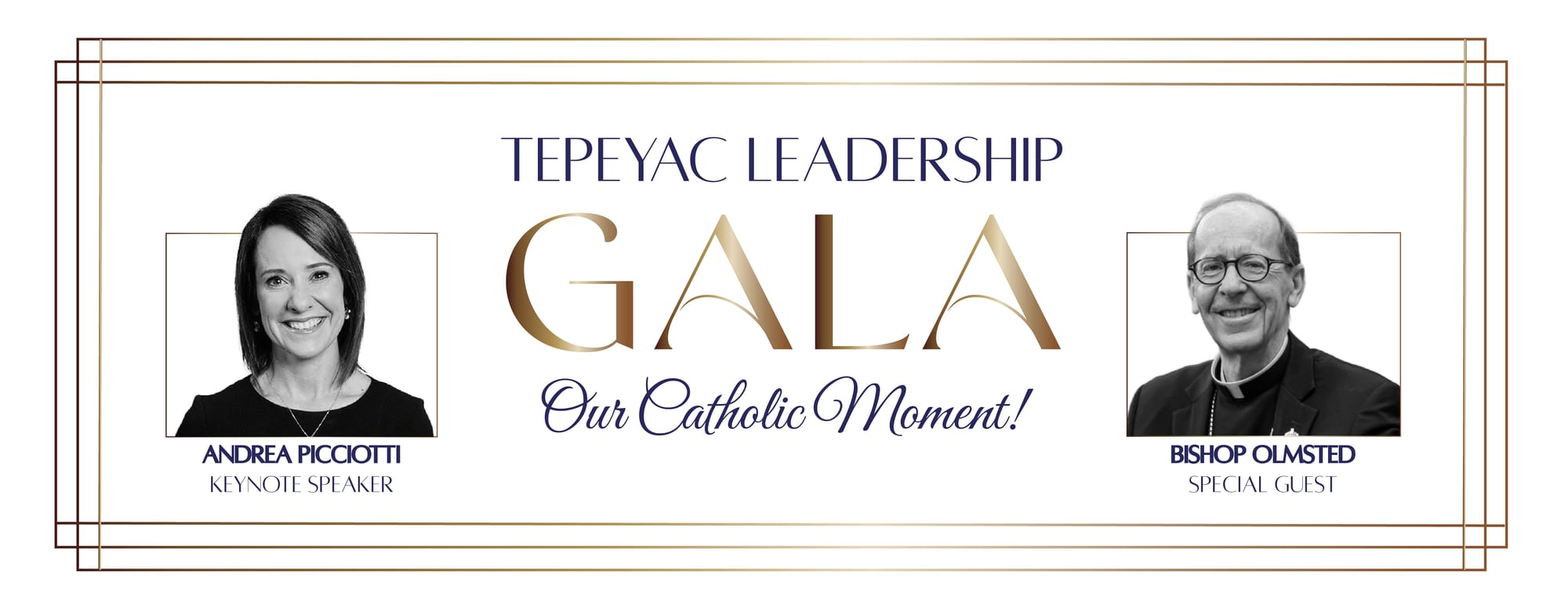
P.S. The countdown is on for the 2nd Tepeyac Leadership Gala, secure your tickets today by clicking below!
A special invitation from Andrea Picciotti.