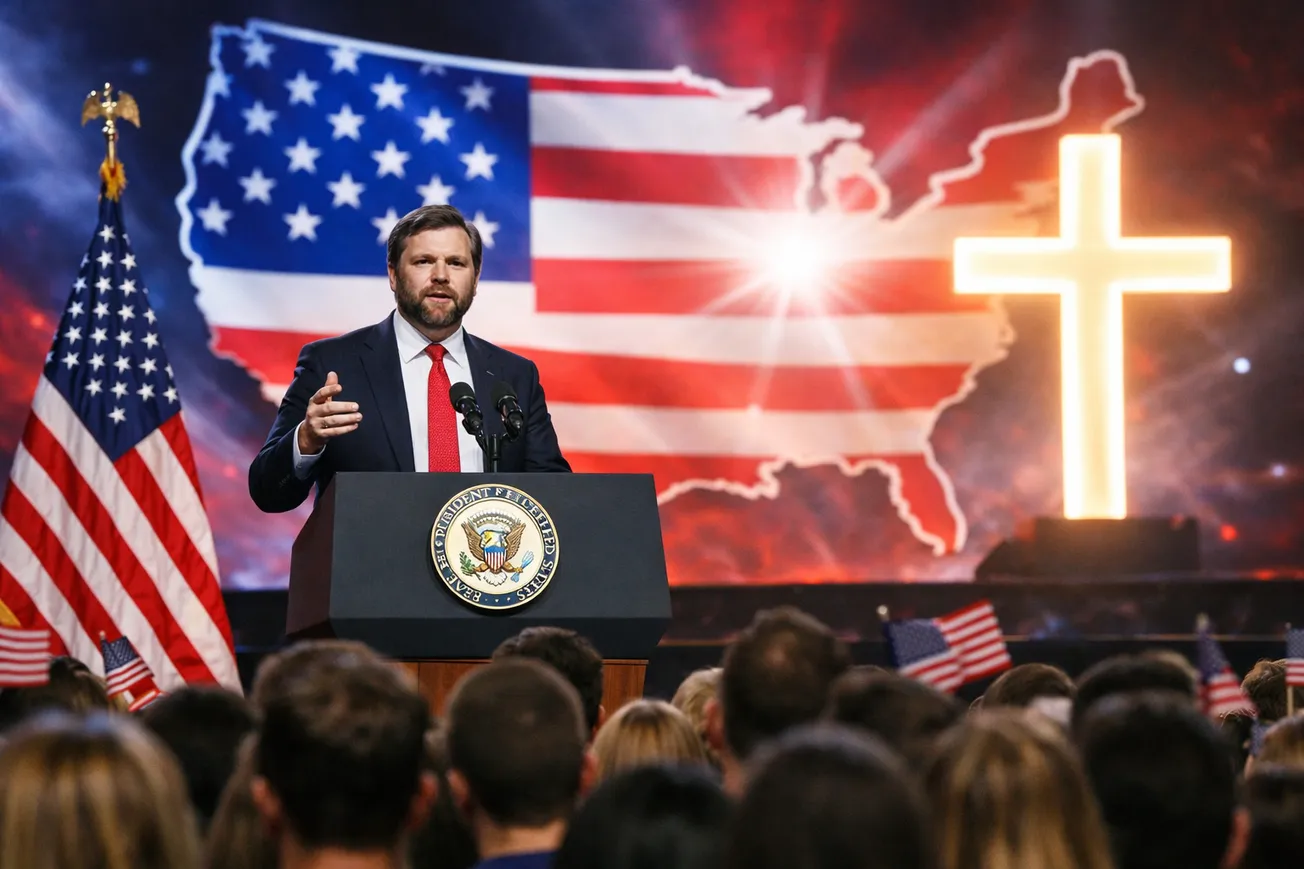
One of the highlights from Turning Point USA’s AmFest 2025 in Phoenix, Arizona (Dec 18 to 21) was the keynote address delivered by Vice President JD Vance, a practicing Catholic, to an audience of roughly thirty thousand young conservatives. Speaking with conviction and personal faith, Vance presented a vision of politics deeply shaped by Christianity and moral order. His remarks resonated strongly with many young adults who are searching for meaning, coherence, and courage in public life at a time of cultural confusion and polarization.
Christian Identity and the American Story
Vance opened by affirming that the enduring anchor of the United States has been its Christian identity. He argued that the nation’s understanding of liberty, conscience, and moral responsibility cannot be separated from Christianity’s influence on its founding. Rather than seeing faith as a private sentiment to be hidden from public view, he presented Christianity as a source of wisdom that has guided the nation toward justice and human dignity.
From a Catholic perspective, this affirmation aligns with the Church’s teaching on natural law. The truths that human life has inherent worth and that freedom must be ordered to its protection and flourishing are not political inventions. They flow from a Christian vision of the human person created in the image of God.
Faith and the Public Square
A central theme of Vance’s address was the rejection of the idea that religious liberty means excluding faith from public life. He challenged the notion that a healthy society requires the removal of Christianity from schools, workplaces, and civic discourse. According to Vance, this removal has created a moral emptiness that is quickly filled by ideologies that weaken families and undermine human flourishing.
Catholic social teaching echoes this concern. Authentic freedom is never detached from truth. When faith is pushed aside, society loses a moral compass. The Church has long taught that believers have both the right and the duty to contribute to public life in a way that reflects the Gospel and serves the common good.
A Vision Rooted in Human Dignity
Vance emphasized that Christian politics must be grounded in a full understanding of the human person. Protecting unborn life and strengthening the family were presented as essential priorities, not as isolated issues but as part of a broader moral vision. He spoke of a society that recognizes duties as well as rights and calls its citizens to responsibility and sacrifice.
For Catholic professionals, this integrated vision is especially meaningful. Our faith does not divide life into spiritual and professional compartments. It calls us to witness to truth in our workplaces, communities, and civic engagement, always with charity and integrity.
Personal Faith and Works of Mercy
The Vice President also shared personal reflections that revealed how faith shapes his outlook. He spoke of loss, hope, and the power of Christian love lived out through concrete acts of service. He highlighted ministries that care for the poor and vulnerable as examples of faith made visible through action.
This emphasis reflects the heart of the Catholic moral tradition. Love of neighbor is not abstract. It is expressed through works of mercy and a commitment to justice. Politics, when rightly ordered, becomes one way of serving others rather than a pursuit of power.
Order, Responsibility, and Love of Neighbor
Addressing policy matters such as immigration, Vance framed his remarks around the concept of rightly ordered love. He argued that care for others begins with responsibility toward one’s own family and community. While these issues remain complex and often debated within the Church, his approach underscored the importance of moral order and prudence in public decision making.
The Church consistently teaches that charity and justice must walk together. Prudence, solidarity, and subsidiarity remain essential guides for Catholic engagement in public policy.
In conclusion, Vice President JD Vance’s address at AmFest 2025 offered encouragement to young believers who seek to live their faith boldly in the public square. For Catholic professionals, his message serves as a reminder that our faith is not merely personal but public in its implications. We are called to bring the light of Christ into cultural and political life, guided by the teachings of the Church, committed to the dignity of every human being, and oriented toward the common good and the glory of God.
P.S. Please consider an end-of-year gift to Tepeyac Leadership. Thank you for investing in the next generation of lay Catholic leaders for the world.