Table of Contents
When longstanding allies like the U.S. and Canada exchange trade warnings, impose punitive tariffs, and engage in economic brinkmanship, the secular business world naturally shifts into damage control. Financial media channels flood our feeds with projections on shrinking profit margins, disrupted supply chains, and consumer price surges.
For executives and entrepreneurs watching these headlines unfold between two long-standing neighbors, the immediate impulse is often anxiety or reactive economic nationalism. But as Catholic professionals, our compass cannot be driven by short-term market panic or political tribalism. We are called to view the marketplace through a far sturdier lens: the timeless principles of Catholic Social Teaching.
The ongoing trade friction between the United States and Canada is not merely a clash of policy; it is a profound test of how we understand human labor, global stewardship, and the common good.
The Illusion of Zero-Sum Economics
Modern commerce often frames trade as a zero-sum game, a fierce contest where one nation’s gain is inherently another’s loss. When economic disputes escalate into trade wars, this underlying philosophy turns neighbors into adversaries and reduces human enterprise to a transactional battleground.
Catholic Social Teaching offers a radical alternative. In Caritas in Veritate, Pope Benedict XVI reminded us that economic activity cannot be compartmentalized from moral truth. Business is fundamentally an exercise in human co-creation, intended to foster mutual human flourishing rather than isolated enrichment.
When trade relations deteriorate between historic allies, the primary casualty is rarely just a corporate balance sheet; it is the human person. Behind every tariff line item are real people: small-scale manufacturers adjusting shift hours, family farmers managing tight margins, and working households absorbing higher costs for basic goods. Re-centering our view around the dignity of human labor allows us to look past nationalistic rhetoric and recognize the shared humanity of workers on both sides of the border.
Subsidiarity in Times of Strain
A key pillar of Church teaching is the principle of subsidiarity, the understanding that decision-making should occur at the most localized, immediate level capable of addressing the need.
High-level trade wars represent top-down economic force. When national leaders deploy broad macroeconomic levers, local communities and mid-sized enterprises are left to weather the fallout.
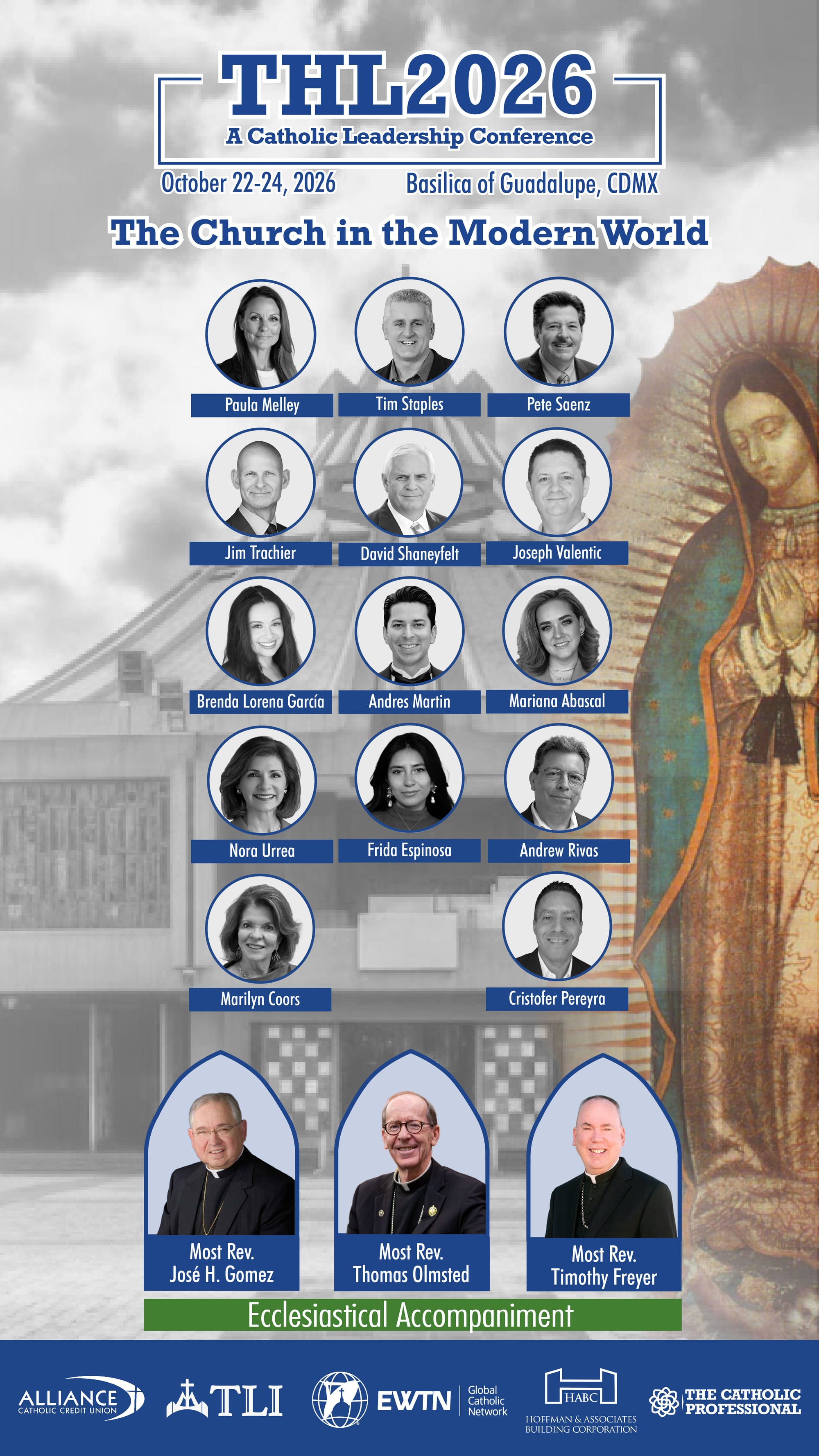
Ad: Discover the place where Our Lady of Guadalupe appeared to St. Juan Diego. See her image. And join Archbishop José Gómez, Bishop Thomas Olmsted and Bishop Timothy Freyer for The Hour of the Laity 2026 in Mexico City.
This is precisely where Catholic business leaders are called to step into the gap. Subsidiarity reminds us that responsibility does not belong solely to heads of state or international trade ministers. As leaders within our own organizations, we hold the power to cushion the impact for our teams and communities. Rather than responding to tariff pressures with immediate layoffs or vendor cancellations, a Catholic executive approaches operational challenges with creative prudence, seeking solutions that preserve employment and honor existing commitments.
Leading with Solidarity and Prudence
How, then, should a Catholic professional navigate this economic landscape?
First, we must prioritize people over panic by refusing to let market uncertainty erode our commitment to employee dignity. Treating workforce stability as a primary goal rather than a secondary consideration ensures that business decisions reflect the true value of human labor.
Second, we are called to cultivate cross-border partnerships while rejecting the temptation to view international colleagues or vendors with suspicion. Doubling down on relational trust, ethical supply chains, and transparent communication keeps community intact even when macroeconomics create distance.
Finally, we must model civil discourse in boardrooms and professional networks by pushing back against polarized, knee-jerk nationalism. Advocating for policies grounded in dialogue, fairness, and long-term economic stability serves the common good far better than short-term retaliation.
Economic disputes will come and go, but our vocation as Catholic professionals remains constant. By anchoring our leadership in solidarity, subsidiarity, and the common good, we can navigate cross-border friction not merely as passive observers of market forces, but as witnesses to a higher standard of business integrity.
P.S. Join Archbishop José Gómez, Bishop Thomas Olmsted and Bishop Timothy Freyer for The Hour of the Laity 2026 in Mexico City. In the videos bellow you will see what they have to say about THL2026.
Ad: Tepeyac Leadership’s Leadership for the World is a $2 million, three year mission to form lay Catholic leaders for the public square. Without formation, others fill the void. Will you step in or step aside now, when it matters most?