Table of Contents
Today the suffering of Christians across the globe is not a distant statistic. It is a lived reality affecting hundreds of millions of our brothers and sisters. For faithful Catholics, this is not simply news. It is a summons to prayer, solidarity, and renewed commitment to religious freedom as a fundamental human right rooted in the dignity of the human person.
Recent data from the Open Doors World Watch List 2026 reveals the highest levels of anti Christian persecution since the index was first published. According to its findings, more than 388 million Christians worldwide experience high levels of persecution or discrimination because of their faith. That means roughly one in seven Christians lives under serious pressure, hostility, or violence for following Christ.
A Global Surge in Hostility
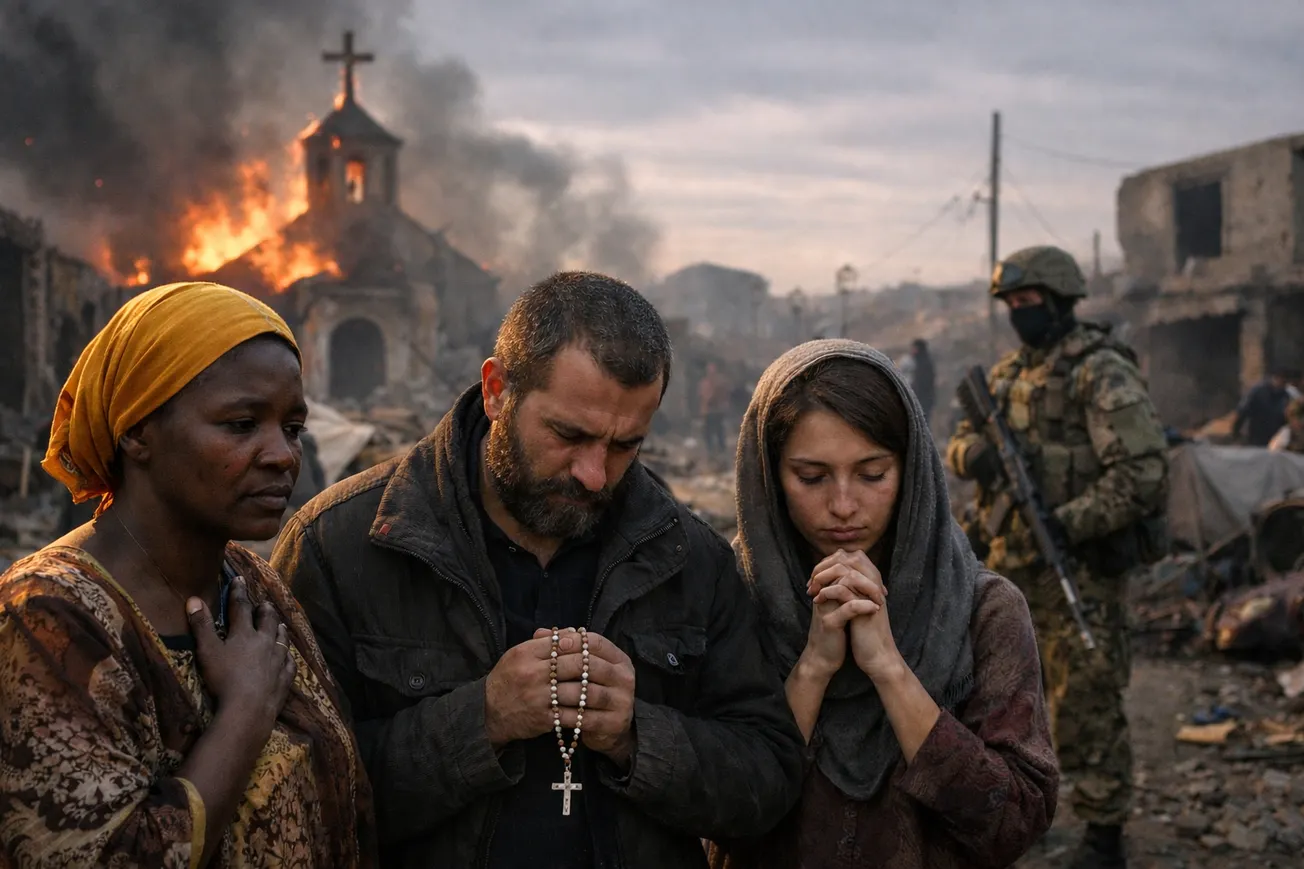
The scope of the crisis is sobering. In the past year alone, tens of thousands of churches, Christian schools, and medical facilities have been attacked, closed, or destroyed. More than 108,000 homes and small businesses belonging to Christians were reportedly looted or demolished. Families have been forced to flee, often with nothing, becoming internal refugees or crossing borders in search of safety.
This reality has created what observers describe as a Church on the move, a scattered community of believers driven from their ancestral lands. The visible Church in some regions is shrinking not because faith has died, but because violence and intimidation have made ordinary Christian life nearly impossible.
Root Causes Behind the Persecution
Several forces converge to produce this surge. Weak governance and the collapse of the rule of law in fragile states allow militias and extremist groups to act with near impunity. Religious extremism, especially in parts of Africa and Asia, deliberately targets Christians as representatives of a rival faith. In other contexts, aggressive nationalism portrays Christians as foreign or subversive elements within society.
Armed conflict further intensifies vulnerability. Where governments cannot or will not protect minorities, Christians often become easy targets. In some cases, persecution is overtly violent. In others, it is systemic, expressed through discriminatory laws, social exclusion, surveillance, and economic marginalization.
Sub Saharan Africa: A Deadly Epicenter
Sub Saharan Africa has emerged as one of the most dangerous regions for Christians. In countries such as Nigeria, thousands of believers have been killed in recent years amid insurgencies and militant activity. Kidnappings, forced displacement, and attacks on villages have devastated entire Christian communities.
In several nations across the region, armed groups exploit instability and poverty. Christians are often singled out for their faith, their churches burned, and their livelihoods destroyed. The scale of violence has reshaped the demographic and spiritual landscape of entire areas.
The Middle East and the Fading of Ancient Communities
In the Middle East, where Christianity was born, ancient communities are rapidly diminishing. In Syria, years of war and the presence of extremist factions have eroded structures that once offered limited protection. Many Christians have emigrated. Others remain under constant pressure, facing restrictions, property seizures, and social hostility.
The disappearance of these historic communities is not merely a regional tragedy. It is a loss for the universal Church and for the cultural heritage of humanity.
Surveillance and Repression in Other Regions
Persecution is not always expressed through open warfare. In Iran, converts to Christianity frequently face arrest, surveillance, and imprisonment, particularly when participating in house churches. Even recognized Christian minorities can encounter legal and social discrimination that limits their ability to worship freely or evangelize.
In parts of Latin America, criminal organizations and authoritarian governments also exert pressure. Christian leaders who speak against corruption, violence, or injustice sometimes face threats, harassment, or worse. When the Gospel challenges systems of exploitation, those invested in such systems may respond with intimidation.
The growing persecution of Christians worldwide confronts Catholic professionals with a profound question. How will we respond? The answer begins with prayer and informed awareness, but it cannot end there. Advocacy for religious freedom, support for organizations aiding persecuted communities, and a renewed commitment to live our faith courageously in our own environments are all essential.
The suffering Church reminds us that fidelity to Christ has always carried a cost. Yet the blood of martyrs has never extinguished the Gospel. Instead, it has purified and strengthened the Church. In standing with persecuted Christians, we affirm not only solidarity with our brothers and sisters, but also the enduring truth that no earthly power can silence the hope that flows from the Resurrection.
P.S. The countdown is on for the 2nd Tepeyac Leadership Gala, on March 28. Secure your tickets today by clicking below!