Table of Contents
In a rapidly changing professional landscape shaped by emerging technologies and shifting workplace structures, many professionals are asking how to remain relevant without losing a sense of stability or purpose. The answer is not merely technical adaptation, but a deeper integration of skill, judgment, and human formation. For the Catholic professional, this moment is also an invitation to approach work as a vocation, where competence and virtue grow together in service of others.
Proactive Upskilling and Responsible Engagement with Technology
One of the most significant shifts in today’s work environment is the increasing presence of artificial intelligence and advanced digital tools across nearly every industry. For professionals, waiting passively for formal training is no longer sufficient. Instead, there is a growing need for proactive engagement with these tools in ways that are thoughtful and grounded in prudence.
From a Catholic perspective, human intelligence is a gift entrusted to us for cultivation and service. Exploring new technologies is not about novelty alone, but about discerning how they can genuinely enhance human work without diminishing human dignity. Professionals are encouraged to experiment with AI tools relevant to their field, not as replacements for judgment, but as instruments that can expand capacity, improve efficiency, and open space for more meaningful tasks.
This experimentation should be guided by moral clarity. Not every technological capability is beneficial simply because it is available. The goal is to understand how these tools reshape output and decision making while ensuring that the human person remains at the center of work.
Visibility and the Articulation of One’s Gifts
As roles become more fluid and traditional job descriptions evolve, professionals are increasingly called to articulate their value in broader terms than a title or position. This involves developing what can be described as a knowledge map, a clear understanding of one’s technical competencies, relational strengths, and intellectual contributions.
In Catholic social thought, work is deeply connected to human identity and participation in the creative action of God. Therefore, making one’s skills visible is not an exercise in self-promotion for its own sake, but a recognition of the gifts one has received and how they are placed at the service of others.
Professionals who can clearly communicate how their skills intersect, adapt, and solve problems are better positioned to serve organizations effectively. More importantly, they resist the reduction of their identity to a single function. They present themselves as integrated persons whose value extends beyond immediate tasks, contributing to a fuller understanding of human work as cooperative and creative.
Leadership Development Rooted in Human Formation
For those in leadership roles, the demands of the present moment extend beyond operational management. Increasingly, effective leadership requires emotional intelligence, the capacity to coach others, and the ability to navigate remote and hybrid team dynamics with clarity and consistency.
Catholic tradition emphasizes that authority is always ordered toward service. Leadership is not domination, but stewardship of persons entrusted to one’s care. Emotional intelligence, in this light, becomes a moral capacity, enabling leaders to recognize the dignity, struggles, and potential of those they lead.
Coaching skills are equally important, as they reflect a commitment to the growth of others rather than simply the completion of tasks. In distributed work environments, where physical presence is limited, leaders must be especially intentional about fostering trust, clarity, and a shared sense of purpose.
The challenge is not only to manage work effectively, but to form environments where individuals can flourish as whole persons.
A Profession Shaped by Purpose and Stewardship
To navigate the future of work faithfully is to embrace both competence and conscience. Proactive learning, clear articulation of one’s gifts, and intentional leadership development are not merely career strategies. They are expressions of stewardship over the talents entrusted to each person.
For the Catholic professional, these practices find their deepest meaning in service. Work becomes a place where intelligence is sharpened, relationships are honored, and leadership is exercised with humility. In this way, the changing world of work is not only a challenge to be managed, but an opportunity to more fully integrate faith, reason, and responsibility in daily professional life.
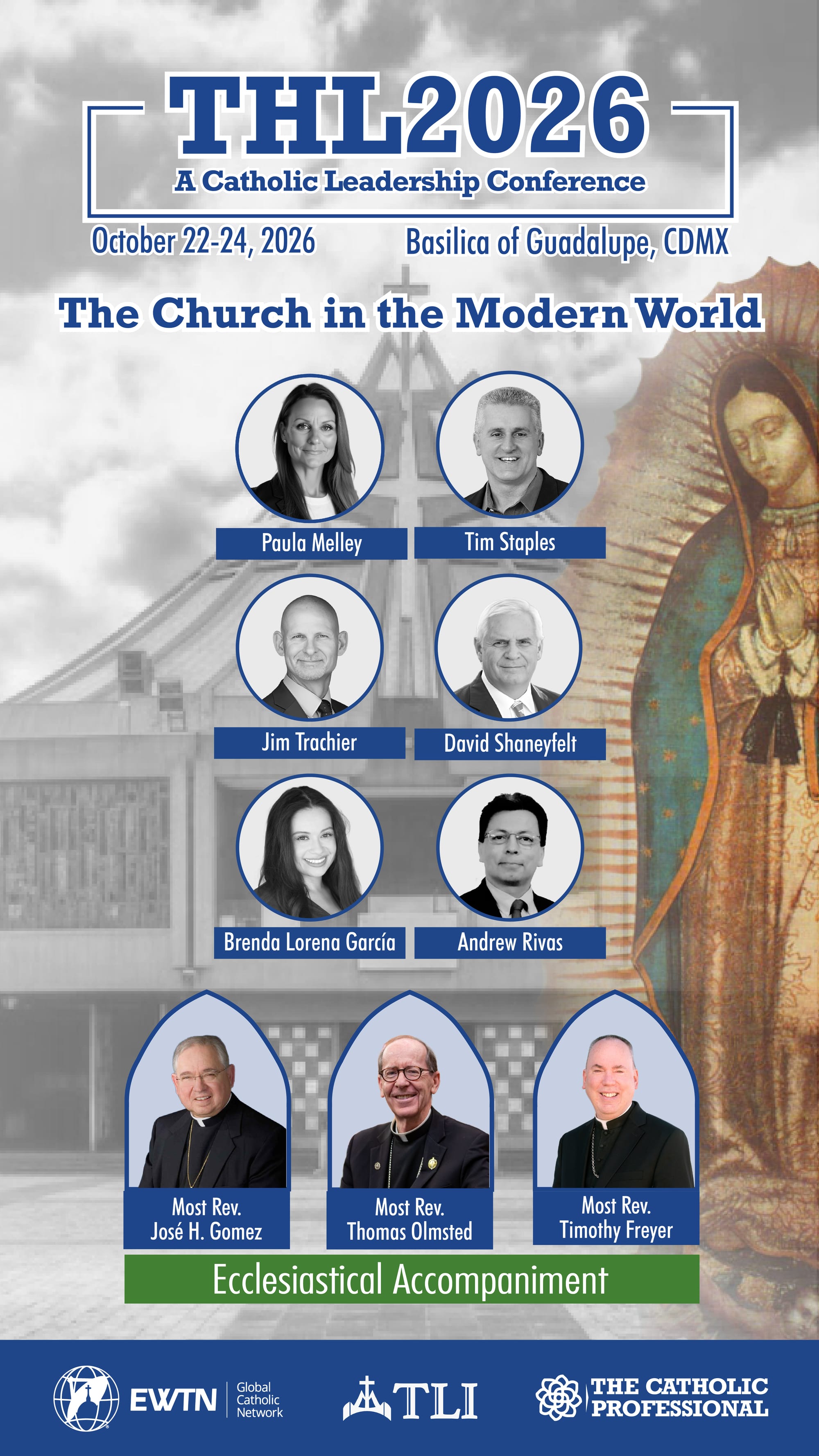
P.S. Discover the place where Our Lady of Guadalupe appeared to St. Juan Diego. See her image. And join Archbishop José Gómez, Bishop Thomas Olmsted and Bishop Timothy Freyer for The Hour of the Laity 2026 in Mexico City.